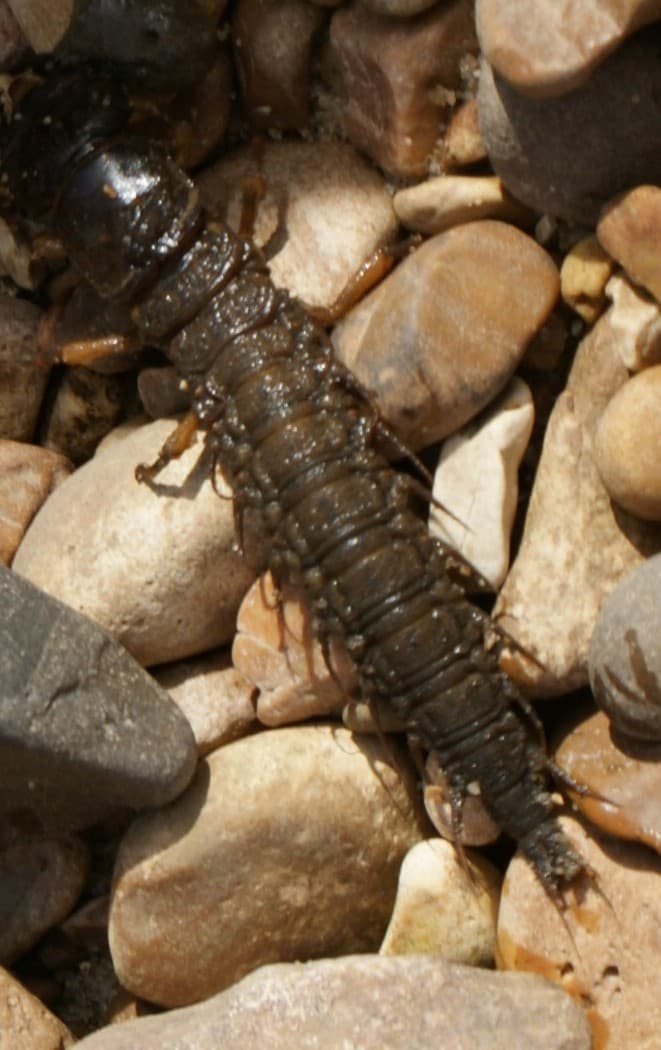
Large dark natural dobsonfly larva on rounded stream rocks with segmented body, lateral filaments, legs, and terminal appendages visibleRepresentative photo · one form in this family

Fly family · guide 95

Hellgrammite Patterns

A large aquatic-larva family with an elongated segmented body, lateral filaments, six thoracic legs, and paired terminal hooks.

Size range
Large nymph sizes; match local larvae and tackle
Common colors
black, dark brown, olive-brown
Imitates
dobsonfly larva, hellgrammite
How to recognize it

Hellgrammite imitations should preserve a long, dark, segmented profile with lateral filaments and a distinct head. Rubber-leg, chenille, realistic, and weighted versions are family variants, not one exact recipe.

Large dark natural dobsonfly larva on rounded stream rocks with segmented body, lateral filaments, legs, and terminal appendages visible
Representative photo · one form in this family

Natural Dobsonfly Larva

Natural-insect reference—not an artificial fly. The National Park Service identifies a dobsonfly larva but not its species; the stream-rock photograph is used for anatomy and habitat context only.

View
family comparison — natural dobsonfly larva on stream rocks
Color shown
dark brown-black with warm-brown legs and filaments
Look for
The larva's large dark head, long segmented body, six thoracic legs, lateral abdominal filaments, and paired terminal prolegs are visible against stream stones.
Open full-size photo

On the water

Choose the right version.

Use these tips as a starting point. The river, depth, insects, and fish behavior still decide the final presentation.

01

Why it works

  • A hellgrammite-style imitation presents a long substantial aquatic-larva profile with repeated segmentation, a distinct head, and movement along both sides of the abdomen.
  • Keeping the artificial near rocky bottom can place that profile in the same broad feeding zone as natural larvae, while flexible lateral materials add movement in current.
  • The three natural references expose meaningful differences in color, head shape, and body pattern, preventing one black rubber-leg fly from becoming the entire family.
02

When to use it

  • In rocky warmwater rivers and mixed fisheries where dobsonfly or related hellgrammite-like larvae are plausible and local evidence supports a large aquatic-larva presentation.
  • For smallmouth and other insect-feeding fish holding near bottom structure, especially when a substantial nymph profile is more credible than a small generic nymph.
  • Choose dark brown, black, olive-brown, mottled, or other colors from local observation; the photographed Nigronia species do not prove what is present on another river.
03

How to fish it

  • Dead-drift or slowly crawl the exact artificial near the bottom with only enough weight to reach the lane and maintain control.
  • Use a short controlled lift or swing only when it preserves a plausible larval path rather than turning the fly into a fast streamer.
  • Inspect the imitation after rock contact so the segmented body, lateral materials, hook point, and terminal profile remain intact and readable.
04

Mistakes to avoid

  • Calling every long rubber-leg nymph a hellgrammite.
  • Omitting the segmented lateral profile that separates it from a generic stonefly.

Make the choice

Choose the form before the color.

A family name is only a starting point. Use the waterline, construction, and observed food to narrow it to the form that fits the river.

  1. Use the National Park Service dobsonfly larva for a dark stream-rock body plan: broad head, long segmentation, lateral filaments, six thoracic legs, and terminal appendages.
  2. Use the Nigronia fasciata photograph for a mottled medium-brown form with a broad dark head and strong contrast across the thorax and abdomen.
  3. Use the Nigronia serricornis photograph for a flatter rust-brown dorsal view that makes the repeated lateral filaments and segmentation especially clear.
  4. Choose the artificial by exact recipe, size, weighting, head, and lateral profile. Rubber-leg, chenille, realistic, and other forms remain unpictured until exact licensed photography is reviewed.

Common variations

Small changes can make a different fly.

Three verified, non-AI natural-larva photographs show an unidentified National Park Service dobsonfly larva plus source-identified Nigronia fasciata and Nigronia serricornis. They clarify larval anatomy and variation; no artificial hellgrammite or local occurrence is visually claimed.

Natural dobsonfly-larva reference

An unidentified dark larva on stream rocks showing the core elongated segmented body plan in habitat context.
Colors shown
dark brown-black, warm-brown appendages
Weighting
Natural insect reference; artificial ballast depends on current and depth.

Natural Nigronia fasciata reference

A source-identified mottled larva with a broad dark head, six legs, lateral filaments, and a long segmented abdomen.
Colors shown
mottled brown, amber, dark mahogany
Weighting
Natural insect reference; no artificial construction or weight is implied.

Natural Nigronia serricornis reference

A source-identified rust-brown larva photographed from above, making its segmented abdomen and repeated lateral appendages easy to compare.
Colors shown
rust-brown, dark mahogany head
Weighting
Natural insect reference; no artificial construction or weight is implied.

Related patterns

Warmwater Bottom Bug and Swimming Nymph PatternsStonefly Nymph PatternsGeneral Nymph PatternsClouser Deep Minnow

How this guide was checked

Fly information and photo sources.

Guide checked on 2026-07-13. Every image has its own source and usage record. Natural insects and hand-tied flies can vary in shape and proportion.

Pattern sources

Fly Fishers InternationalFly of the Month: HellgrammiteOrvis Learning CenterFinding and Catching Smallmouths

Image credits