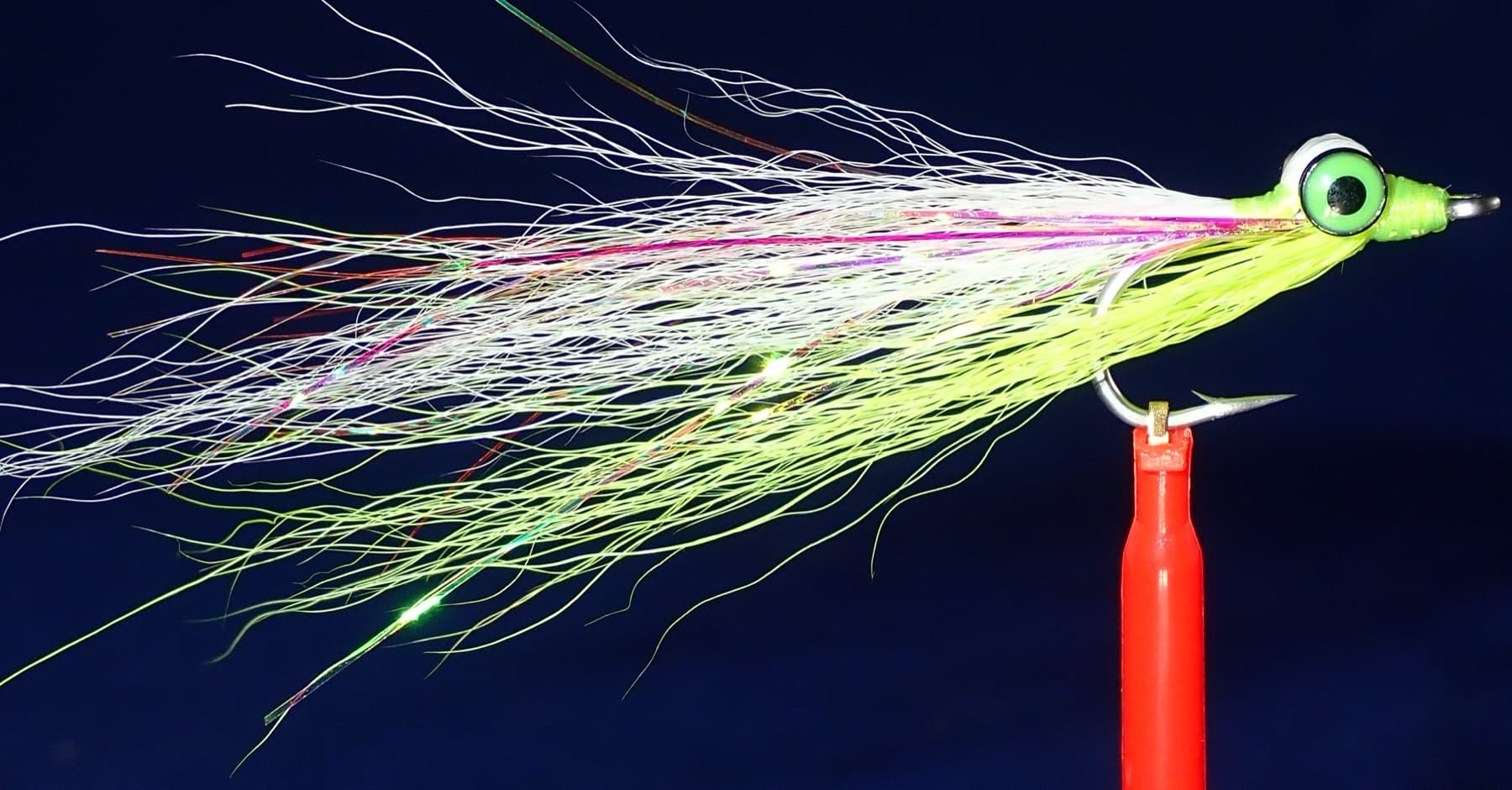
Traditional chartreuse-and-white Clouser Deep Minnow in side profile against a dark blue backgroundReal photo · Traditional chartreuse-and-white Clouser Deep Minnow

Streamer · guide 87

Clouser Deep Minnow

Bob Clouser's sparse dumbbell-eye baitfish pattern, designed for smallmouth bass and now used across fresh and salt water.

Common size
The FFI guide documents a #4 example; regional forms vary
Common colors
chartreuse and white, olive and white, tan and white, locally matched baitfish colors
Imitates
small baitfish, fleeing minnow
How to recognize it

The reviewed chartreuse-and-white form uses sparse layered bucktail with flash around lead barbell eyes. The eyes make the fly sink between strips and ride hook point up; color, eye weight, hook, and saltwater materials must remain labeled.

Traditional chartreuse-and-white Clouser Deep Minnow in side profile against a dark blue background
Real photo · exact pattern

Traditional chartreuse-and-white Clouser Deep Minnow

The primary identification view for the traditional chartreuse-and-white bucktail variation.

View
traditional side profile
Color shown
chartreuse and white with pearl flash and painted dumbbell eyes
Look for
The side profile exposes the sparse layered wing, flash between colors, and eyes mounted ahead of the dressing.
Open full-size photo

On the water

Know when and how to fish it.

Use these tips as a starting point. The river, depth, insects, and fish behavior still decide the final presentation.

01

Why it works

  • Dumbbell eyes pull the front of the fly down between strips and help it ride hook point up, producing the pattern's characteristic jigging path.
  • Sparse layered hair or feather and flash create a translucent baitfish profile that moves with relatively little material; color and eye weight can then be chosen for the water rather than treated as fixed.
02

When to use it

  • For smallmouth, other bass, panfish, and mixed fisheries where baitfish are plausible.
  • Around rocky structure or deeper lanes where an inverted, jigging fly reduces—but does not eliminate—snags.
  • In stained water or low light when a contrasting or flash-forward baitfish profile helps fish locate the fly.
03

How to fish it

  • Strip with pauses that let the dumbbell eyes tip the fly downward.
  • Match eye weight to depth rather than treating every Clouser as a deep fly.
  • Use a loop knot when additional freedom of movement is appropriate for the leader and target species, and inspect it after contact with cover or fish.
04

Mistakes to avoid

  • Calling every dumbbell-eye bucktail a Clouser Deep Minnow.
  • Showing a heavily dressed or differently weighted form without labeling it.

At the vise

Tie this version.

Traditional chartreuse-and-white Clouser Deep Minnow · intermediate

Eye mass, hook, wing material, flash, and color control sink rate and silhouette. Feather-wing, gold-and-copper, and Fire Tiger examples are shown as named variations, not as the traditional chartreuse-and-white recipe.

Materials

Hook
Straight-eye streamer hook appropriate to the target species; the reviewed FFI example uses size 4
Thread
White or chartreuse strong tying thread
Eyes
Painted dumbbell or barbell eyes sized for the intended depth
Lower wing
Sparse white bucktail
Flash
Pearl or baitfish-toned flash
Upper wing
Sparse chartreuse bucktail
Finish
Durable head cement or resin around the eye wraps

Steps

  1. Secure the hook and establish a thread base at the eye position, leaving room behind the hook eye for a finished head.
  2. Mount the dumbbell eyes squarely on top of the shank with firm figure-eight and locking wraps so the hook will invert while fishing.
  3. Advance the thread and secure a sparse white bucktail wing without flaring it into a bulky bundle.
  4. Add a restrained layer of flash between the lower and upper wing colors, trimming it to varied baitfish lengths.
  5. Turn the hook as needed and secure a sparse chartreuse bucktail wing so the layers remain separated around the eyes.
  6. Build a compact durable head, reinforce the eye wraps, finish the thread, and allow the coating to cure fully.

Tying source: Fly of the Month: Clouser Deep Minnow

Common variations

Small changes can make a different fly.

Four verified, non-AI photographs show the traditional chartreuse-and-white form plus feather-wing, gold-and-copper, and Fire Tiger variations. Material and color changes are labeled on every image.

Traditional chartreuse and white

Sparse chartreuse-over-white bucktail with flash and forward dumbbell eyes.
Colors shown
chartreuse, white, pearl flash
Weighting
Dumbbell-eye mass varies; choose it for the intended depth and current.

Chartreuse feather-wing variation

A chartreuse variation replacing some of the traditional bucktail profile with feather material.
Colors shown
chartreuse, pale feather, flash
Weighting
Painted dumbbell eyes; exact mass is not established by the photograph.

Gold and copper variation

A flash-forward warm-metallic color variation retaining the Clouser eye placement and inverted architecture.
Colors shown
gold, copper, silver flash
Weighting
Painted dumbbell eyes; exact mass is not established by the photograph.

Fire Tiger variation

A high-contrast chartreuse, orange, and black attractor color scheme.
Colors shown
chartreuse, orange, black, flash
Weighting
Painted dumbbell eyes; exact mass is not established by the photograph.

Related patterns

Warmwater Baitfish PatternsChocklett's Game ChangerWoolly Bugger

How this guide was checked

Fly information and photo sources.

Guide checked on 2026-07-12. Every image has its own source and usage record. Natural insects and hand-tied flies can vary in shape and proportion.

Pattern sources

Fly Fishers InternationalFly of the Month: Clouser Deep MinnowOrvis Learning CenterFinding and Catching Smallmouths

Image credits