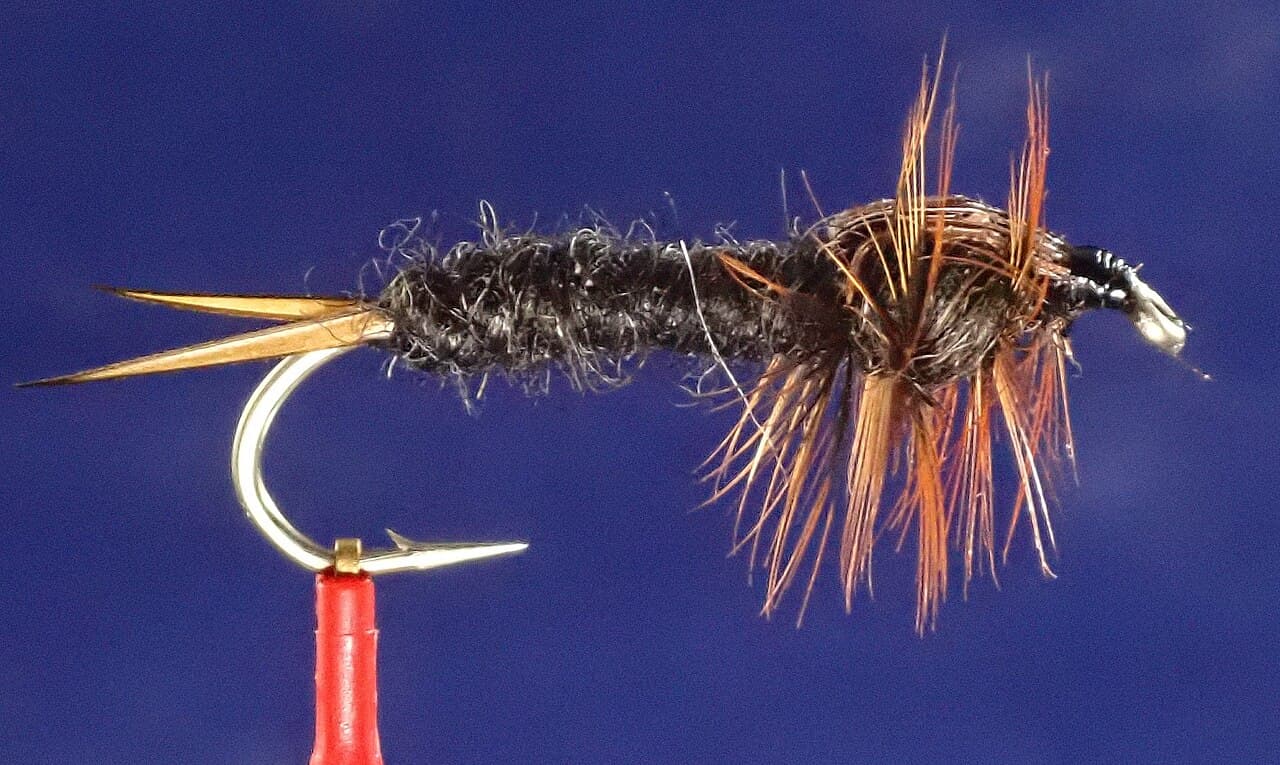
Side photograph of a black-and-brown Box Canyon Stone nymph patternRepresentative photo · one form in this family

Fly family · guide 18

Stonefly Nymph Patterns

A broad family of two-tailed, bottom-oriented stonefly nymph imitations in many sizes and weights.

Size range
#4–18 depending on species
Common colors
black, brown, olive, golden
Imitates
stonefly nymph
How to recognize it

Stonefly nymph patterns generally emphasize two tails, a broad thorax, segmented abdomen, and bottom contact; rubber legs, biots, beads, and jig hooks define different exact forms.

Side photograph of a black-and-brown Box Canyon Stone nymph pattern
Representative photo · one form in this family

Box Canyon Stone

The Box Canyon Stone represents a broad, traditionally dressed stonefly nymph rather than every modern rubber-leg form.

View
family comparison — broad traditional profile
Color shown
black and brown
Look for
A long two-tailed abdomen and pronounced hackled thorax create a broad traditional stonefly profile.
Open full-size photo

On the water

Choose the right version.

Use these tips as a starting point. The river, depth, insects, and fish behavior still decide the final presentation.

01

Why it works

  • Stonefly nymphs are substantial bottom-dwelling food, so a broad segmented profile can represent a high-value meal in appropriate freestone habitat.
  • Close imitations and suggestive rubber-leg forms solve different problems: one emphasizes shape and segmentation, while the other emphasizes motion.
  • The family spans large dark and smaller pale forms, making observed size and color more useful than the word stonefly by itself.
02

When to use it

  • In clean, well-oxygenated freestones where stonefly nymphs live among rocks and coarse substrate.
  • Before adult activity, during higher flows, or when nymphs migrate toward shore before emergence.
  • When turning a rock or reviewing a current local report confirms the size and color family present in that watershed.
03

How to fish it

  • Dead-drift the selected form close to the bottom through riffles, pockets, and seams without forcing it to scrape every rock.
  • Choose fly weight, split shot, or a tight-line presentation for the specific lane; the family name does not establish one universal ballast.
  • Before emergence, finish selected drifts toward the bank or shallower edge where migrating nymphs may concentrate.
04

Mistakes to avoid

  • Treating size or color as universal.
  • Calling every rubber-leg nymph one exact pattern.

Make the choice

Choose the form before the color.

A family name is only a starting point. Use the waterline, construction, and observed food to narrow it to the form that fits the river.

  1. Choose the Kaufmann Black Stone when a dark, more imitative segmented silhouette matches the observed nymphs.
  2. Choose a Rubber Legs form when broken water and current make flexible motion more useful than fine anatomical detail.
  3. Choose a smaller pale form, such as the photographed Little Yellow Stonefly nymph, only when local insects support that size and color.
  4. Use the Box Canyon Stone as a broad traditional reference—not as proof that every river's stoneflies share its proportions or materials.

Common variations

Small changes can make a different fly.

Four verified, non-AI photographs compare a Box Canyon Stone, Kaufmann Black Stone, suggestive Rubber Legs form, and smaller Little Yellow Stonefly nymph. The guide shows family range without turning those named flies into one recipe.

Box Canyon Stone

A broad traditionally dressed form with paired tails and a pronounced thorax.
Colors shown
black, brown, tan accents
Weighting
The photograph does not prove internal weight; rig for the target lane.

Kaufmann Black Stone

A dark, more imitative form with visible segmentation, wing cases, tails, and legs.
Colors shown
black, dark brown
Weighting
Stonefly nymphs are commonly weighted, but exact ballast cannot be inferred from this photograph.

Rubber Legs form

A suggestive variegated body with long flexible legs that emphasize movement.
Colors shown
dark variegated body, tan legs
Weighting
Select weight for depth; the visible fly has no bead or external weight.

Little Yellow Stonefly nymph

A smaller pale example that makes the family's real size and color range visible.
Colors shown
yellow, amber, brown
Weighting
No bead or external weight is visible.

Related patterns

Prince NymphStimulatorChubby Chernobyl

How this guide was checked

Fly information and photo sources.

Guide checked on 2026-07-13. Every image has its own source and usage record. Natural insects and hand-tied flies can vary in shape and proportion.

Pattern sources

Orvis NewsTop 5 Patterns for the Early-Season Skwala HatchOrvis NewsInsect Facts: The Family Stone

Image credits