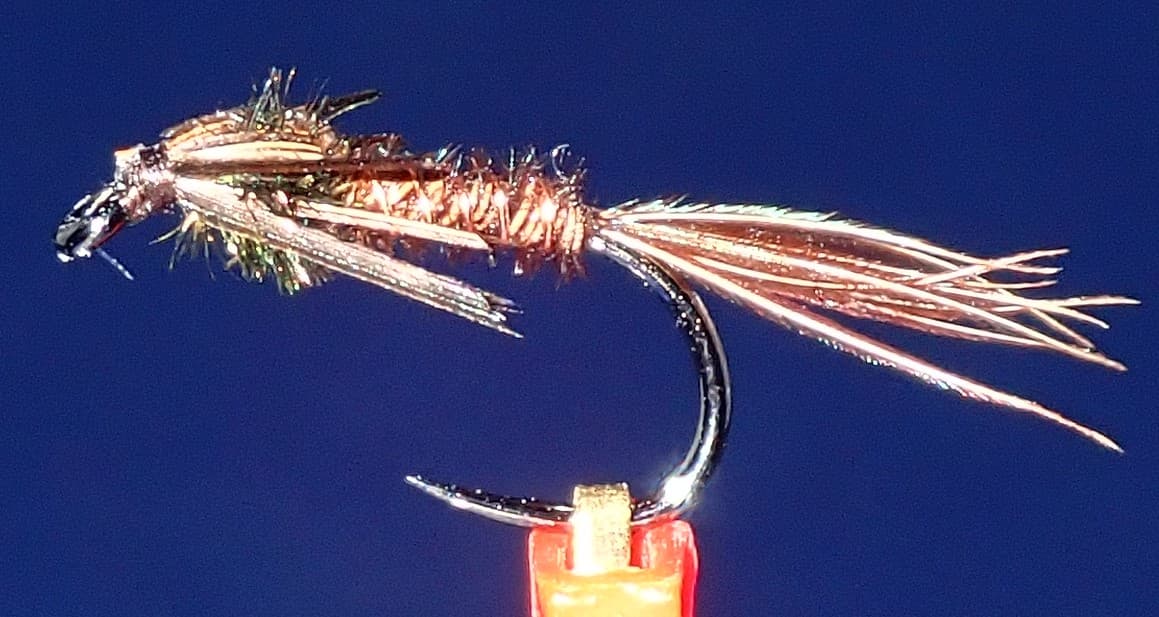
Side profile of an American Pheasant Tail Nymph against a dark blue backgroundVerified exact-pattern photograph
← Fly Box

Nymph · guide 02

Pheasant Tail Nymph

A compact mayfly-nymph pattern whose pheasant-tail fibers and copper rib create a slim, segmented profile.

Common size
#12–20
Colors reviewed
natural pheasant brown, copper rib
Imitates
mayfly nymph, small stonefly nymph in larger sizes, damselfly nymph in still water
How to recognize it

The pilot page distinguishes the sparse original idea from the bulkier American form. Both use pheasant-tail fibers and copper wire, but bead heads, peacock-herl thoraxes, legs, flashbacks, jig hooks, and soft-hackle collars are variations that must be labeled.

Frank Sawyer developed the sparse original Pheasant Tail Nymph for English chalk streams. Al Troth later created the fuller American form reviewed in this tying guide by adding a peacock-herl thorax and more prominent legs.
Side profile of an American Pheasant Tail Nymph against a dark blue background
Exact-pattern photograph

American Pheasant Tail Nymph

The clean side profile is the primary identification view for this pilot page.

View
side profile
Color shown
natural pheasant brown and copper
Look for
Shows the slim abdomen, thorax, legs, and tail proportions.
Open full-size photo

On the water

Understand it. Then fish it.

The river, depth, insects, and fish behavior still decide the final presentation. These are reviewed starting points—not a claim about what is happening today.

01

Why it works

  • The slim, segmented body matches the profile of many mayfly nymphs without adding unnecessary bulk.
  • Pheasant-tail fibers and copper wire create natural brown tones, fine movement, and a clear segmented effect.
  • The same recognizable profile can be tied sparse and unweighted or adapted with clearly labeled weight when a deeper presentation is needed.
02

When to use it

  • When mayfly nymphs are active in riffles, seams, tailouts, or still-water edges.
  • As a dropper when trout are feeding below a visible hatch.
  • As a general natural-profile nymph when no single hatch is obvious.
03

How to fish it

  • Dead-drift the fly near the bottom, then allow a controlled lift at the end of the drift when emerging insects are plausible.
  • Fish a sparse unweighted form higher in the column and a labeled bead-head or weighted form when depth is the priority.
  • Adjust depth and drift before assuming the pattern itself is wrong.
04

Mistakes to avoid

  • Treating Sawyer's sparse original, the American version, flashback, bead-head, jig, and soft-hackle versions as visually identical.
  • Calling any brown nymph a Pheasant Tail without the recognizable fiber-and-wire construction.
  • Adding an exact size or weight to a river recommendation when the local report has not reviewed it.

At the vise

Tie the reviewed form.

Unweighted American Pheasant Tail Nymph · intermediate

This guide covers the unweighted American form. Sawyer's sparse original, bead-head, flashback, jig, and soft-hackle versions should remain separately labeled.

Materials

Hook
2X-long nymph hook, sizes 12–20
Thread
Brown 6/0 or 70-denier thread
Rib
Small copper wire
Tail and abdomen
Dark brown pheasant-tail fibers
Thorax
Peacock herl
Wing case and legs
Dark brown pheasant-tail fibers
Head
Brown tying thread
Finish
Head cement

Steps

  1. Secure the hook and establish a smooth brown-thread base toward the bend.
  2. Tie in the small copper wire and a measured bundle of pheasant-tail fibers, leaving the tips as the tail.
  3. Wrap the pheasant-tail fibers forward to build a slim abdomen, then secure them before the thorax area.
  4. Counter-wrap the copper wire through the abdomen to reinforce the fibers and create visible segmentation.
  5. Tie in a fresh pheasant-tail section for the later wing case and legs, then build the thorax with peacock herl.
  6. Pull the pheasant-tail fibers over the thorax as the wing case and arrange the remaining fibers as the American form's legs.
  7. Build a small thread head, finish the fly, and apply a minimal amount of head cement.

Reviewed tying source: Orvis News

Variant control

Small changes matter.

Three exact licensed photographs show the American profile from the side and head-forward plus a sparse tying-bench form. Flashback and soft-hackle versions are withheld for separately named pages.

American Pheasant Tail

A fuller form commonly shown with a peacock-style thorax and visible legs.
Colors shown
natural pheasant brown, copper, peacock tones
Weighting
Unweighted and bead-head versions both exist; the image label must state which is shown.

Sparse unweighted form

A slim tying-bench form closer to the sparse original profile.
Colors shown
natural pheasant brown, copper
Weighting
Unweighted in the reviewed image.

Review trail

Sources, rights, and limits.

Pattern facts were reviewed on 2026-07-12. Every image has its own rights record; photographed hand-tied flies may still vary slightly in proportion.

Pattern sources

Orvis NewsPro Tips: Why You Should Always Carry Pheasant Tail NymphsOrvis NewsHow to Tie the American Pheasant Tail Nymph

Image credits

CC BY-SA 4.0Mike Cline, via Wikimedia Commons, CC BY-SA 4.0CC BY-SA 4.0Mike Cline, via Wikimedia Commons, CC BY-SA 4.0CC BY-SA 2.0Rexness, via Wikimedia Commons, CC BY-SA 2.0