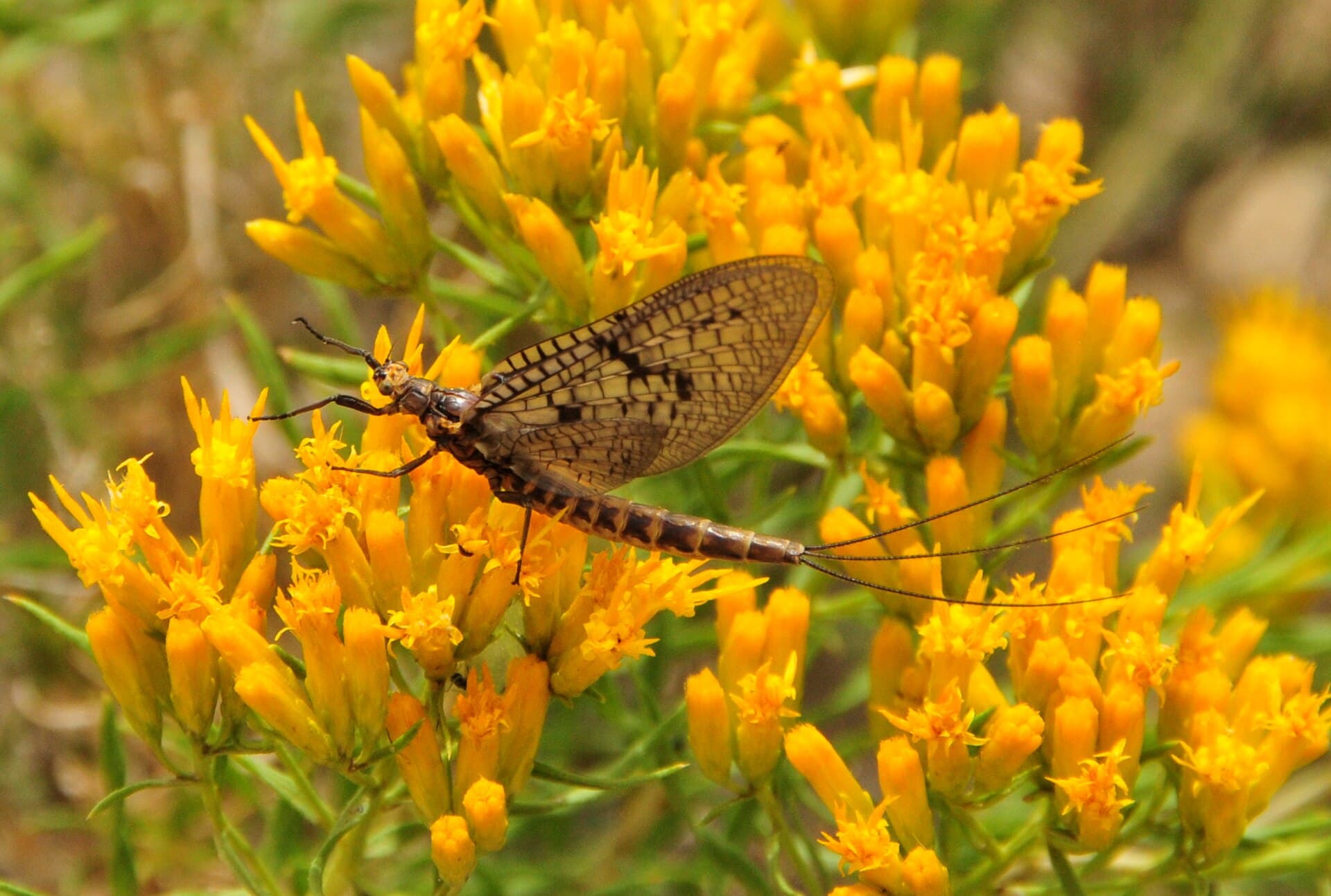
Large natural Brown Drake Ephemera simulans adult with mottled upright wings and three long tails resting on yellow rabbitbrush flowersRepresentative photo · one form in this family

Fly family · guide 46

Brown Drake Patterns

A large-mayfly family separating Brown Drake nymphs, emergers, duns, and pale Coffin Fly spinner forms.

Size range
Large mayfly sizes; verify locally
Common colors
mottled brown, tan, cream spinner
Imitates
Brown Drake mayfly stages, Brown Drake spinner or Coffin Fly
How to recognize it

Brown Drake usually refers to the large burrowing mayfly Ephemera simulans in North American fly-fishing use, but a river report may mean a nymph, emerger, newly emerged adult, dun, or spinner. Natural adults have a long three-tailed abdomen and large, heavily veined, brown-mottled upright wings. Coffin Fly wording belongs to the pale spent-spinner lane and should never be applied to the brown dun or the burrowing nymph.

Large natural Brown Drake Ephemera simulans adult with mottled upright wings and three long tails resting on yellow rabbitbrush flowers
Representative photo · one form in this family

Brown Drake Adult

Natural adult—not an artificial Brown Drake dry. The U.S. Fish and Wildlife Service source identifies Ephemera simulans and describes it as newly emerged at Seedskadee National Wildlife Refuge; that observation is not a current hatch or occurrence claim for another river.

View
life-stage comparison — source-identified Ephemera simulans newly emerged adult
Color shown
mottled brown body with translucent brown-marked wings
Look for
The bright field photograph clearly shows the large adult's long three-tailed abdomen, upright heavily veined wings, dark wing spots, long forelegs, and substantial scale.
Open full-size photo

On the water

Choose the right version.

Use these tips as a starting point. The river, depth, insects, and fish behavior still decide the final presentation.

01

Why it works

  • A Brown Drake event moves a large mayfly meal from a burrowing nymph below the surface to emerging, upright adult, and spent-spinner positions, so fish can concentrate on a very different silhouette at each stage.
  • The two exact Ephemera simulans adult photographs make scale, mottled wing pattern, long forelegs, abdomen, and three tails readable; the different-species larva supplies only the broad burrowing-body clues that an adult cannot show.
  • A useful artificial matches the current waterline and local size before color. One large mottled dry cannot honestly cover a buried nymph, struggling emerger, upright dun, and flat pale spinner.
02

When to use it

  • Only during a locally established Brown Drake window when current reports, nymphal shucks, adults, spinner activity, or observed feeding supports the choice.
  • Use a locally matched burrowing-nymph imitation before or during movement from the bottom, an emerger or dun only as insects reach the surface, and a flat Coffin Fly-style spinner only when pale spent adults are actually present.
  • Expect some activity near dusk on documented waters, but treat time and season as a planning clue rather than a live hatch claim; verify the river and stage that day.
03

How to fish it

  • Fish an exact Brown Drake nymph imitation along the plausible bottom-to-surface migration path with enough rig weight to reach the lane while preserving a large, mobile burrowing-nymph profile.
  • Present an emerger or dun without drag in the observed rise lane, changing stage before simply changing color when fish take just below or in the film.
  • Fish a verified pale spinner pattern flat and nearly motionless during a real spinner fall. The natural adults in this gallery are recognition references, not the artificial to tie on.
04

Mistakes to avoid

  • Calling a dun a Coffin Fly spinner.
  • Assuming all drakes share color or behavior.

Make the choice

Choose the form before the color.

A family name is only a starting point. Use the waterline, construction, and observed food to narrow it to the form that fits the river.

  1. Use the U.S. Fish and Wildlife Service Ephemera simulans adult for the complete Brown Drake adult outline: large mottled upright wing, long body, three tails, and substantial scale.
  2. Use the source-identified male Ephemera simulans photograph for honest hand scale, very long forelegs, large eyes, and adult color variation; it is not a separate artificial pattern.
  3. Use the Ephemera guttulata larva only for broad same-genus burrowing anatomy—large head, tusk-like mouthparts, legs, gills, long abdomen, and three tails. It is a different species and is not pictured or labeled as a Brown Drake nymph.
  4. Choose the fishable artificial by exact stage and recipe. Brown Drake nymph, emerger, dun, and pale Coffin Fly spinner constructions remain unpictured until exact licensed fly photographs pass review.

Common variations

Small changes can make a different fly.

Three verified, non-AI photographs compare two source-identified Ephemera simulans adults with a scientific Ephemera guttulata larva photograph used only for same-genus burrowing anatomy. The larva is visibly labeled as a different species; exact Brown Drake nymph, emerger, dun artificial, and pale Coffin Fly spinner patterns remain unpictured.

Natural Brown Drake adult

A source-identified newly emerged Ephemera simulans adult showing full wing, abdomen, leg, and tail proportions.
Colors shown
mottled brown, tan, translucent wing
Weighting
Natural adult reference; no artificial construction or flotation claim is implied.

Natural male Brown Drake

A second exact Ephemera simulans adult at hand scale showing long forelegs, large eyes, patterned wing, abdomen, and tails.
Colors shown
deep brown, black mottling, translucent wing
Weighting
Natural adult reference; no artificial construction or local hatch is implied.

Different-species Ephemera larva anatomy

An Ephemera guttulata scientific photograph used only to explain broad burrowing-larva architecture within the genus.
Colors shown
pale yellow-tan, dark internal line
Weighting
Natural different-species larva reference; not a Brown Drake nymph or fly recipe.

Related patterns

Mayfly Patterns by StageGreen Drake PatternsHex Mayfly PatternsRusty SpinnerSparkle Dun

How this guide was checked

Fly information and photo sources.

Guide checked on 2026-07-13. Every image has its own source and usage record. Natural insects and hand-tied flies can vary in shape and proportion.

Pattern sources

Orvis NewsHow to Match the HatchOrvis NewsPhil's Top 6 Patterns for Spring Mayfly Hatches

Image credits