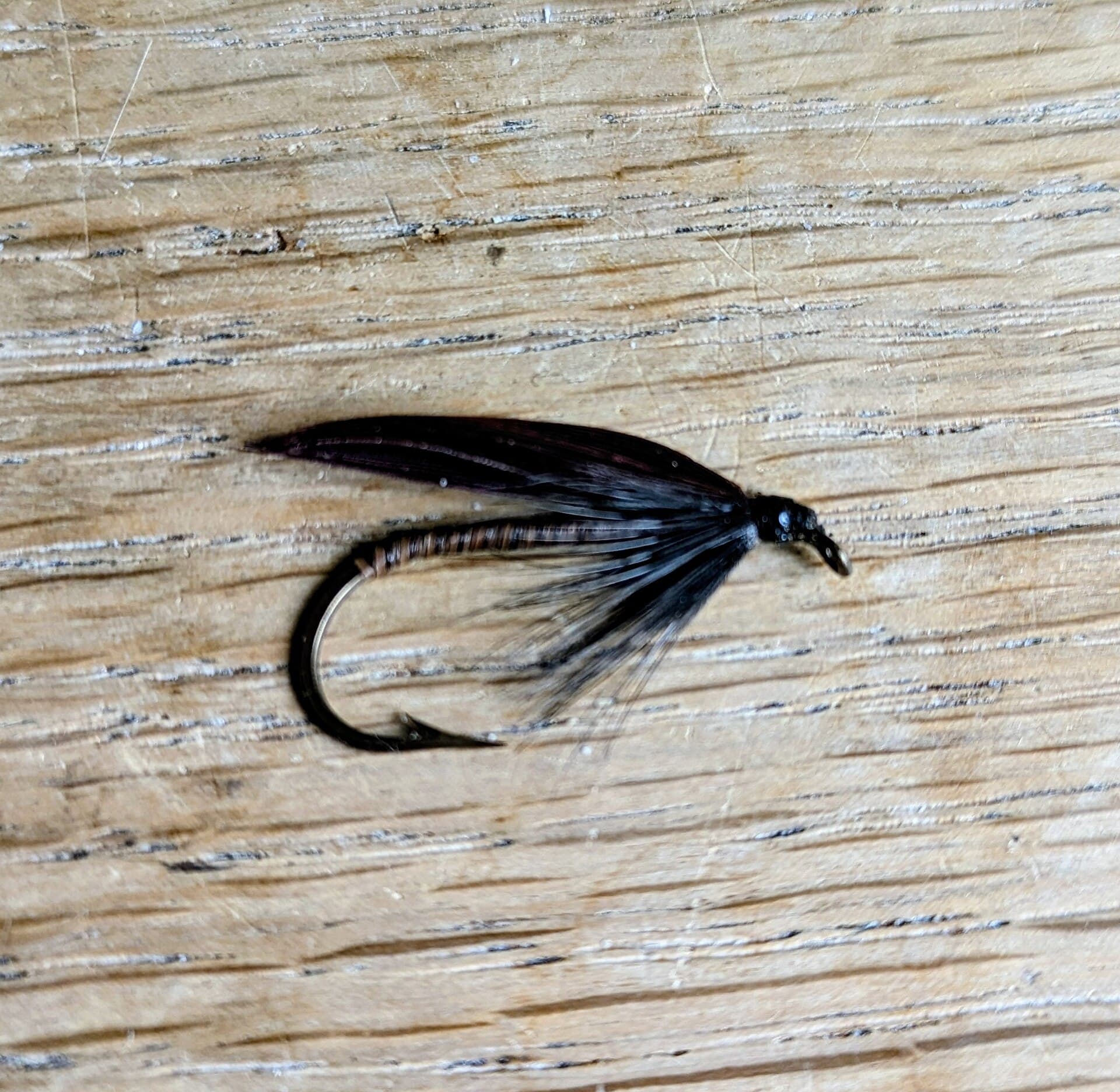
Close overhead photograph of a dark Blue Quill wet fly with swept slate wings, black hackle, a segmented quill body, and short tailRepresentative photo · one form in this family

Fly family · guide 49

Blue Quill Patterns

A small eastern mayfly family for Blue Quill nymphs, emergers, duns, and spinners.

Size range
Small mayfly sizes; verify locally
Common colors
dark gray, olive-brown, slate wing
Imitates
Blue Quill mayfly stages
How to recognize it

Blue Quill is hatch wording rather than one mandatory recipe. The traditional dry is only one adult imitation; subsurface and spent stages need different profiles.

Close overhead photograph of a dark Blue Quill wet fly with swept slate wings, black hackle, a segmented quill body, and short tail
Representative photo · one form in this family

Blue Quill Wet Fly

The source identifies this exact artificial as a Blue Quill wet fly. It is one subsurface construction—not the natural insect, dry dun, or spent spinner.

View
stage comparison — exact Blue Quill wet fly
Color shown
dark slate wing, black hackle, dark quill body, and short dark tail
Look for
A dark swept wing, sparse black hackle, segmented quill body, and short tail create a traditional wet-fly profile below or in the film.
Open full-size photo

On the water

Choose the right version.

Use these tips as a starting point. The river, depth, insects, and fish behavior still decide the final presentation.

01

Why it works

  • Blue Quill is a hatch label, so nymph, rising wet or emerger, upright dun, and spent spinner require different depths and silhouettes even when their colors overlap.
  • The exact Blue Quill wet fly supplies a dark swept-wing subsurface form, while the natural Paraleptophlebia references make the slim nymph and small upright-wing adult body plans visible.
  • Publishing the species limits prevents a European Paraleptophlebia photograph or a genus-only nymph from becoming false proof of the exact insect on an eastern North American river.
02

When to use it

  • During a locally established early-season Blue Quill window when current observations, shucks, adults, or a trusted report support the hatch.
  • Use a small nymph before emergence, the exact wet fly or another verified low form during the rise, an upright dry only when duns are present, and a spent-wing pattern only when spinner behavior is observed.
  • Match the insect actually present; Blue Quills can overlap blue-winged olives, Quill Gordons, and Hendricksons, and trout may select only one species during a mixed hatch.
03

How to fish it

  • Dead-drift a small nymph at the depth indicated by the water, then move the presentation toward the film as emergence becomes visible.
  • Fish the photographed Blue Quill wet fly on a controlled dead drift, lift, or soft swing without describing it as an upright dry or spent spinner.
  • For surface feeding, choose an exact locally matched Blue Quill dry or spinner and preserve a drag-free drift; the natural photographs are recognition references, not fishable flies.
04

Mistakes to avoid

  • Using the hatch name as one exact recipe.
  • Confusing Blue Quill and Quill Gordon solely by name.

Make the choice

Choose the form before the color.

A family name is only a starting point. Use the waterline, construction, and observed food to narrow it to the form that fits the river.

  1. Choose the exact photographed Blue Quill Wet Fly for a dark swept-wing subsurface approach with sparse hackle and a segmented quill body.
  2. Use the natural Paraleptophlebia nymph only to read genus-level wing pads, lateral gills, body shape, and three tails before selecting an artificial.
  3. Use the natural P. submarginata adult only as a genus-level upright-wing anatomy reference; it is a European species, not proof of the local North American Blue Quill.
  4. Open an exact Blue Quill dry or spinner source when the fish are taking duns or spent adults; those artificial forms are not represented by this gallery.

Common variations

Small changes can make a different fly.

Three verified, non-AI photographs compare an exact Blue Quill wet fly with genus-level natural Paraleptophlebia nymph and adult references. The natural adult is European P. submarginata and is explicitly limited to genus anatomy rather than claimed as a North American Blue Quill species.

Blue Quill Wet Fly

An exact dark swept-wing wet fly with sparse hackle, a segmented quill body, and short tail.
Colors shown
slate black, dark brown, gray
Weighting
Unweighted wet fly; rig and leader control depth.

Natural Paraleptophlebia nymph reference

A genus-level natural nymph reference showing wing pads, gills, six legs, and three tails.
Colors shown
brown, pale tan
Weighting
Not applicable; this image shows a natural insect.

Natural Paraleptophlebia submarginata adult reference

A European natural adult shown only for genus-level upright-wing anatomy and mottled-wing comparison.
Colors shown
dark mottled wing, reddish brown
Weighting
Not applicable; this image shows a natural insect.

Related patterns

Mayfly Patterns by StageSoft-Hackle Wet FliesAdams Dry FlyRusty SpinnerQuill Gordon Patterns

How this guide was checked

Fly information and photo sources.

Guide checked on 2026-07-13. Every image has its own source and usage record. Natural insects and hand-tied flies can vary in shape and proportion.

Pattern sources

Orvis NewsHow to Match the HatchOrvis NewsPhil's Top 6 Patterns for Spring Mayfly HatchesOrvis NewsHow to Tie a Blue Quill VariantOrvis NewsA Better Way to Strip Peacock Quills

Image credits