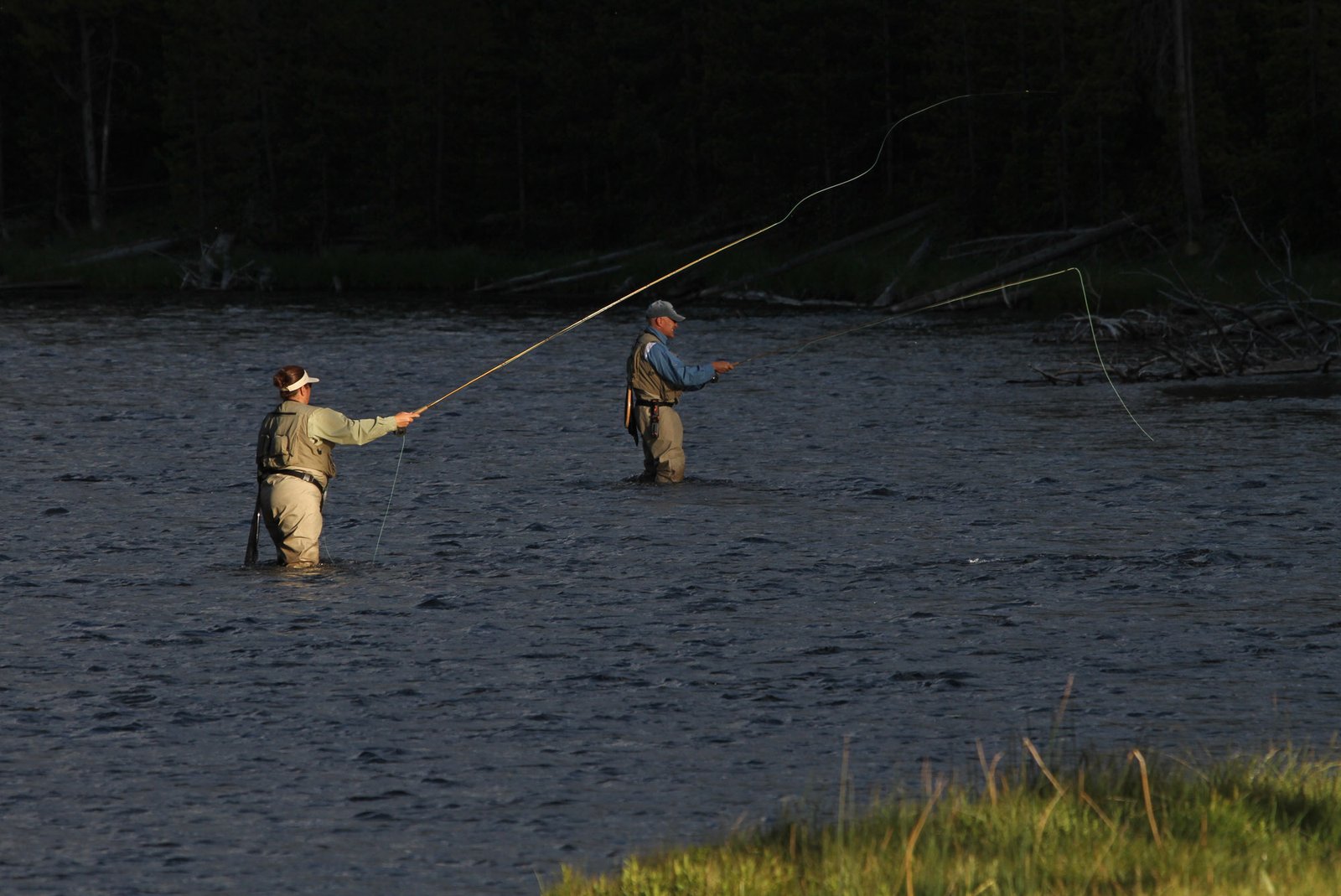
Start with one clean cast
Most beginners do not need ten casts on day one. They need one repeatable cast that puts the fly in front of a fish without panic, slack, or a hooked hat.
Start with the pick-up-and-lay-down cast. Keep the fly line straight on grass or quiet water, lift the rod smoothly, pause long enough for the line to straighten behind you, then make a forward stroke and stop the rod so the loop can unroll.
Think of the cast as three parts: remove slack, wait for the line, then stop the rod. The stop is what gives the line a clean loop instead of a pile.
- Use yarn or a practice fly until the motion feels safe.
- Wear eye protection before you cast with a hook.
- Start with a straight line and as little slack as possible.
- Use a smooth lift, a real pause, and a firm forward stop.
- Aim for clean delivery before extra distance.
Practice before you fish
Practice should feel simple. A lawn, field, pond edge, or wide gravel bar is better than a brushy trout stream when you are still learning the motion.
A good first goal is not a long cast. It is a quiet 25-foot cast that lands mostly straight. That catches more beginner fish than a long cast with slack, splash, and tangled line.
- Set a paper plate, leaf, or hat on the grass and cast near it.
- Practice at 20 to 30 feet before trying to reach farther.
- Stop when the line is straight instead of waving the rod constantly.
- Keep the fly away from people, pets, cars, windows, and overhead lines.
| Practice block | Goal | Stop when |
|---|---|---|
| First 5 minutes | Make short casts with yarn and no hook. | The line lands mostly straight three times in a row. |
| Next 10 minutes | Aim near a small target at 20 to 30 feet. | The fly lands close without extra false casts. |
| Final 5 minutes | Practice one roll cast setup and one clean pickup. | You can reset the line without rushing. |
A short practice plan keeps beginners focused on control before distance.
Use a roll cast when there is no room behind you
A roll cast helps when a normal backcast is blocked by brush, a steep bank, a high wall, or another angler. It is also useful for a quick reset on small creeks and streams.
The roll cast is not a magic fix for every tight spot. It still needs room in front of you, safe footing, and enough water or line tension to form the cast.
- Use it when brush or a bank blocks your backcast.
- Use it to reset line on small streams.
- Use it when a normal false cast would be unsafe or annoying.
- Do not use it as an excuse to stand in unsafe current.
Choose water that makes casting easier
The first fishing spot should help you, not punish you. Open banks, moderate current, safe footing, and a short cast are better than tight trees and fast pocket water on your first day.
For a first day, the best water is not always the famous water. It is the water where you can stand safely, make one short cast, and see what the fly is doing.
- Pick an access with open room behind or beside you.
- Look for soft edges, inside bends, pools, and broad riffle tails.
- Avoid steep banks, blind crossings, and heavy current while learning.
- Choose bank fishing if the river is fishable but not friendly for wading.
Common beginner casting mistakes
Most bad beginner casts come from rushing. The line needs time to straighten. If you start the next stroke too soon, the cast collapses, the leader piles up, and the fly lands with a slap.
The other big mistake is trying to cast too far. Fish often sit closer than beginners think, especially along banks, seams, and soft water next to current.
Use the result of the cast as feedback. A beginner does not need to diagnose every detail. Fix the simple problem first.
- Too much wrist movement instead of a controlled rod stroke.
- No pause on the backcast.
- Starting with slack on the water or grass.
- False casting too much instead of fishing the fly.
- Practicing in brush, wind, or unsafe water too early.
- Trying to reach far fish before learning close fish.
| What you see | Most likely cause | Fix |
|---|---|---|
| Leader lands in a pile | You started the forward cast before the backcast straightened. | Pause longer and stop the rod higher. |
| Fly snaps or pops | The forward stroke started too hard or too soon. | Slow down and make a smoother acceleration. |
| Line will not lift cleanly | Too much slack is on the grass or water. | Strip in slack and start with the line straight. |
| Cast slaps the water | The rod tip dropped too low on the forward stroke. | Stop the rod higher and let the loop unroll. |
| You keep catching brush | The spot does not fit a normal backcast. | Move, roll cast, or pick a more open access. |
Most beginner casting problems improve when you remove slack, pause longer, and stop the rod cleanly.
A simple first-river plan
Pick one easy access, one short rig, and one realistic casting lane. Spend the first 20 minutes making clean short casts before you worry about changing flies.
Then fish close water first. Cast to the edge, the foam line, the inside seam, or the soft tailout before you walk through it. Move less than you think, and make each cast with a reason.
If flow, storms or difficult wading make the river unsuitable, practice from a safe shore or on grass instead.
- Check the river report and skip if water, heat, storms, or access look wrong.
- Start with open bank water before wading.
- Fish 20 to 35 feet first.
- Change position before forcing a harder cast.
- End the session with one thing to practice next time.